Math Games - Brain Training
- 4.3
- Rating
- 10.00M
- Installs
- Free
- Price
 Analysis by App-foxy
I came to Math Games - Brain Training expecting a quick collection of arithmetic exercises, and that is exactly where its appeal begins. It is a free educational game from Pavel Olegovich, aimed at both children and adults, with a simple purpose: give your brain short mathematical challenges that can fit into ordinary spare time. After using it, I found it less like a traditional game with a story and more like a compact mental workout that turns calculation into a repeatable habit.
The first impression is practical rather than dramatic. The presentation keeps attention on the problem in front of you, which suits a game built around thinking instead of exploration. There is no need to learn a fictional world or understand a complicated control scheme before starting. You can open it when you have a few quiet minutes and begin working immediately. That directness is one of its strongest qualities, although people looking for a rich adventure, character progression, or a highly expressive visual style may find it too restrained.
How Math Games - Brain Training turns simple puzzles into a playable routine
I found the game works best when I treat each puzzle as a small, purposeful check-in rather than a score to chase. That approach makes it easier to notice whether I am practising recall, rebuilding focus, or sharing a low-pressure activity with a child. Next, I look at how its straightforward presentation supports that routine—and where the same simplicity can start to feel limiting.
You May Also Like

 Blood Strike: 2.5 Anniversary
Blood Strike’s Loadouts Turn Every Drop Into a Tactical Gamble
A close look at Blood Strike’s custom loadouts: how fast access to signature weapons reshapes its battle royale rhythm, rewards preparation, and narrows the gap between fights.

 Pandora - Music & Podcasts
Pandora’s Music Is Easy to Start, but Harder to Recover
Pandora’s strength is its low-effort path from a seed to a station. Its weak spot is how much confidence it asks you to place in connection, setup, and quiet recovery.

 8 Ball Pool
 Is Built on Rivalries, Rematches, and Routine
A close look at the rivalries, rematches, shared routines, and unanswered safety questions that turn a quick pool match into a persistent mobile community.

 Samsung Music
’s Quiet Strength Is Playing What You Already Own
Its reach comes less from spectacle than from dependable access to a personal library. That simplicity is both the app’s strongest retention engine and its ceiling.

 AccuWeather: Weather Radar
AccuWeather Review: A Quick, Clear Forecast for Everyday Decisions
For everyday plans, the best forecast is the one you can understand quickly. AccuWeather makes rain timing, radar, and local conditions easy to act on, with a few trade-offs.

 Hill Climb Racing
Why Hill Climb Racing Still Turns Crashes Into One More Run
A tiny car, a bumpy hill and one more upgrade: Hill Climb Racing keeps resurfacing because its simple chaos makes every near-miss feel personal.
More From Our News Desk



A focused first impression for quick sessions
The most useful way to approach this game is as a flexible exercise rather than a title you must play for long stretches. I can imagine using it while waiting for an appointment, taking a short break from work, or giving a child something constructive to do during a quiet part of the day. The short-question format makes it easy to stop without feeling that you have abandoned a large campaign. That matters for a brain-training game because consistency is usually more valuable than one exhausting session.
Its broad audience is clear from the design. Younger players can use it to practise basic mathematical thinking, while adults can treat the same kind of activity as a warm-up or a way to keep calculation familiar. The game does not need to pretend that arithmetic is an epic quest. Its playable mood comes from concentration, quick decisions, and the small satisfaction of getting an answer right.
The game is available at no cost, and its age classification is Everyone, making it a reasonable candidate for families who want an approachable mathematics activity. It was released on February 19, 2017, and the current version is 1.157-free. Devices running Android 7.0 or later can use it. Those details make it especially easy to consider for an older compatible phone or tablet that might not handle demanding modern games comfortably.
One practical tip is to decide what you want from a session before opening it. If I am trying to improve speed, I focus on answering promptly and accept that a few mistakes may happen. If I am helping a child build confidence, I slow down and discuss the method instead of treating every question as a race. The same app can serve both purposes, but the experience changes depending on whether accuracy, speed, or calm repetition is the priority.
A visual language built around the question
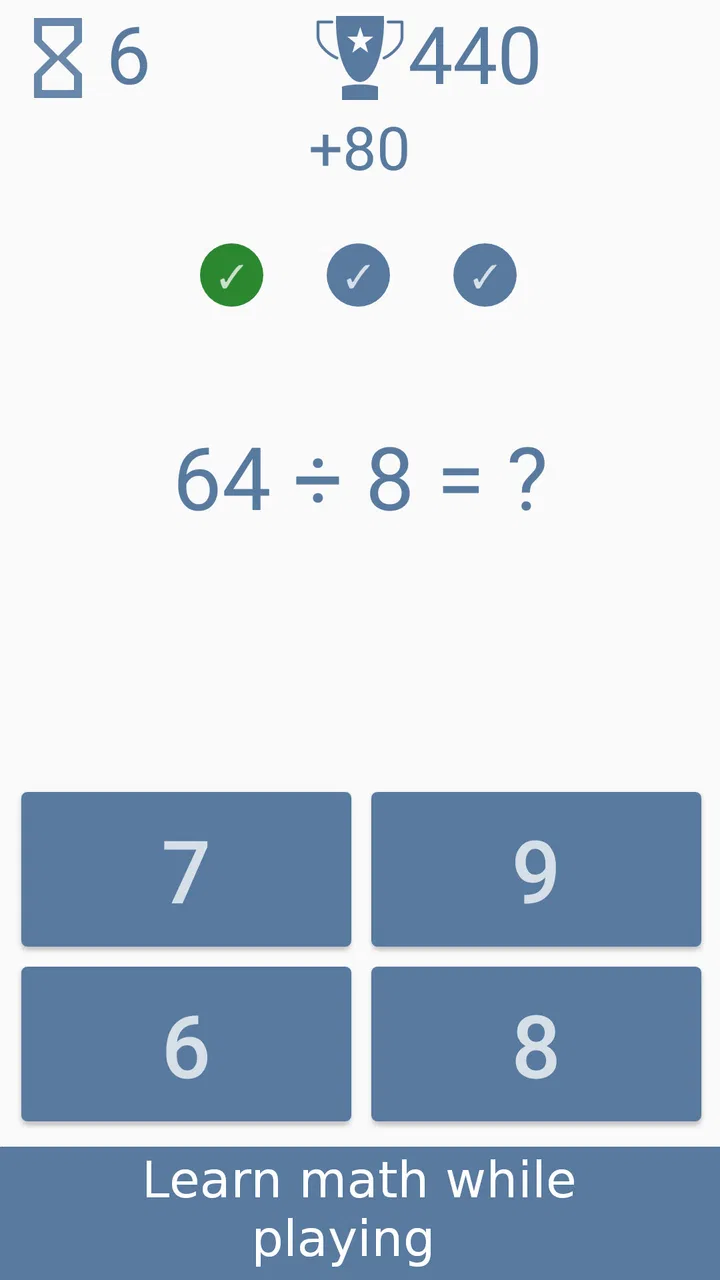
The art direction is intentionally functional. Rather than using a busy setting to compete with the numbers, the game presents mathematics as the central visual object. That creates a clean, task-oriented atmosphere: the screen tells me what to solve, and my attention stays with the operation. For an educational title, this restraint makes sense because decorative elements can easily become distractions, especially for younger players who are still learning to separate the question from everything around it.
This also gives the game a particular identity. It does not create a memorable fictional place, but it does create a consistent mental space where each round feels like a small challenge placed directly in front of me. The lack of narrative is not automatically a weakness. In this case, it prevents the setting from promising something the mechanics cannot deliver. The world is mathematics itself, expressed through repeated problems and the gradual feeling that familiar operations are becoming easier to process.
That visual simplicity has a trade-off. Players who need colourful characters, animated rewards, or a changing environment to stay engaged may lose interest sooner than they would in a more theatrical educational game. I would not choose this as the only learning tool for a child who becomes motivated mainly by story and visual discovery. It works better for someone who already accepts the satisfaction of solving a problem as a reward.
For parents or tutors, the understated presentation can actually be useful. It leaves room for conversation. Instead of asking a child to follow a complicated game world, I can ask why a particular answer makes sense, which operation was used, or whether there is a faster way to reach the result. That makes the app a starting point for practice rather than a substitute for explanation. The best results come when the player pauses to understand errors instead of tapping through them.
Sound, silence, and the rhythm of concentration
The mood of a mathematics game depends less on spectacle than on whether it allows concentration to settle. Here, the rhythm comes from moving from one problem to the next. Each prompt creates a small cycle: read, calculate, choose or enter an answer, then continue. That repeated structure can feel pleasantly meditative when I am in the right frame of mind, because the game gives me a narrow task and removes the need to manage a larger world.
It is worth treating the audio environment as part of your personal setup rather than expecting the game to provide a full musical atmosphere. I prefer using a quiet room or low-distraction background sound when working through calculation exercises. A child may enjoy a more active setting, while an adult using the game as a focus exercise may benefit from keeping other notifications and media out of the way. The app’s rhythm is strongest when the surrounding environment does not interrupt it.
This pacing also explains why the game can be more useful in brief visits than in marathon sessions. Repetition helps reinforce familiar operations, but too much of it can become tiring. I would use a short stopping rule, such as ending after a natural pause or once concentration starts to slip. Continuing after that point can turn a helpful exercise into careless tapping, which teaches less and makes the experience feel more frustrating than it needs to be.
One non-obvious advantage of this measured rhythm is that it exposes the difference between knowing a method and recalling it quickly. When I have time to work through a problem, I may understand it perfectly; under a quicker pace, hesitation shows which facts still need practice. That makes the game useful as a diagnostic routine. I can notice whether mistakes come from misunderstanding, rushed reading, or simple recall gaps, then adjust the next session accordingly.
Where the mechanics fit real learning
The mechanics fit the game’s educational purpose because the core interaction is uncomplicated: face a mathematical puzzle and work toward the answer. There is value in that narrow focus. A complicated control system would add friction without improving arithmetic practice. The player’s main decisions are mental, and the interface serves as the place where those decisions are tested.
For children, I would introduce it alongside paper rather than treating the screen as the entire lesson. A useful routine is to let the child attempt a problem independently, then write down one that caused difficulty and solve it again away from the device. This reveals whether the challenge was the calculation itself or the pressure of answering on screen. It also turns a quick game into a more complete learning loop: attempt, review, explain, and try again.
For adults, the strongest use case is maintenance rather than advanced study. Someone preparing for a formal mathematics exam, learning algebra in depth, or needing detailed lessons should choose a structured educational course with explanations and a planned syllabus. This game is better for keeping basic numerical thinking active, adding a short challenge to a daily routine, or breaking the habit of reaching for passive entertainment during every spare moment.
Compared with flashcards, the game feels more interactive because each exercise asks me to make a decision rather than merely recognise a familiar card. Compared with a classroom or tutoring app, it is lighter and less explanatory. Compared with a large puzzle adventure, it offers less variety in setting and emotional reward but creates fewer distractions. I see it as the middle ground between a worksheet and a conventional game: more engaging than static practice for some players, but not a complete teaching system.
A second practical tip is to vary the context in which you use it. If every session happens while distracted, the results may reflect attention rather than mathematical ability. Try one session in a quiet setting and another during a normal break. If accuracy drops sharply in the noisier situation, the useful lesson may be about concentration, not arithmetic. That makes the game a small self-observation tool as well as a source of exercises.
Who will enjoy it, and who should choose something else
I would recommend it to families wanting a straightforward mathematics activity, adults who enjoy short mental challenges, and players who prefer a clean task over a story-heavy game. It is also a sensible option for someone who wants to turn idle moments into practice without committing to a long course. The fact that it has passed ten million installs and holds a 4.3 average from around sixty-three thousand ratings suggests that this uncomplicated format has found a substantial audience, though popularity alone does not guarantee that its style will suit everyone.
I would be more cautious about recommending it to learners who need step-by-step teaching. If a wrong answer leaves you unsure why you made the mistake, repeated questions may not solve the underlying problem. A tutor, textbook, or lesson-based app would be better when explanations are essential. I would also point elsewhere for players who need a strong reward system, a story, extensive customisation, or a visually changing world to remain motivated.
Another limitation is that a simple exercise loop can expose differences in confidence. A child who already feels anxious about mathematics may interpret mistakes as failure if an adult focuses only on speed or scores. I would frame each attempt as information: which operation was difficult, what method was tried, and what can be checked next time. Used that way, the game supports practice. Used as a constant test, it may make the subject feel more pressurised.
The developer, Pavel Olegovich, has kept the concept narrow enough that the app is easy to understand without a long introduction. That clarity is valuable, but it also means the experience depends heavily on your willingness to supply your own goals. The app can provide the prompts; it cannot decide whether you are practising multiplication facts, rebuilding confidence, or simply looking for a quick challenge. A little planning from the player makes the same content much more effective.
An everyday scenario that shows its best use
Imagine a parent and child waiting before an afternoon activity. Instead of handing over a game with a complicated story, the parent opens this one and suggests trying a few problems together. The child answers independently, and the parent asks them to explain one answer rather than immediately correcting every mistake. After the session, they note the type of problem that caused hesitation and revisit it later with pencil and paper. That is a realistic role for the app: a convenient prompt for shared practice, not a replacement for patient teaching.
An adult can use the same pattern alone. During a work break, I might complete a brief set, notice that I am making errors with a familiar operation, and stop before frustration takes over. Later, I can return when I am more alert and see whether the problem was fatigue. This approach is more useful than chasing an impressive streak or rushing through questions simply to finish. The value lies in noticing patterns in my thinking.
Because the game is free, it is easy to try without turning the decision into a financial commitment. That makes it suitable for testing with different age groups in a household. The Everyone rating supports that broad accessibility, while the Android requirement of 7.0 or later means older devices still have a chance of being useful if they meet the system requirement. I would check the device before planning a shared activity, especially when relying on an older tablet.
My verdict on the atmosphere and the long-term fit
After looking at the art direction, sound-and-rhythm relationship, setting, and mechanics together, I think the game succeeds because they all point toward the same mood: quiet, direct concentration. Nothing needs to compete with the mathematical task. The pacing encourages small sessions, the visual language keeps the problem central, and the mechanics make mental work the main form of play. That coherence is more important here than visual novelty.
Its weaknesses are closely connected to its strengths. The focused design can feel repetitive, the restrained presentation may not excite players who want spectacle, and the exercise format cannot replace detailed instruction. Those are not minor points to overlook, especially if you are choosing an app for a learner who needs explanations or strong emotional motivation. In those cases, a lesson-driven alternative or a more game-like educational experience would be a better fit.
For me, the best reason to keep it installed is convenience. It offers a low-friction way to practise basic mathematical thinking whenever I have a spare moment, and it can support a parent-child routine without requiring a large setup. I would use it in short, purposeful sessions, review mistakes instead of ignoring them, and switch to another learning resource when the goal moves beyond quick puzzle practice.
My final recommendation is simple: choose it if you want mathematics to feel like a compact daily challenge rather than a full course. It is free, accessible to a broad age range, and focused enough to become a habit. Math Games - Brain Training will not satisfy someone searching for a rich game world, but for practical arithmetic practice with a calm, uncluttered mood, it earns a place on the home screen.
FAQs for Math Games - Brain Training
01What is Math Games - Brain Training?
Math Games - Brain Training is a collection of short, interactive exercises designed to improve calculation speed, concentration, memory, and logical thinking. In my experience, the app focuses on approachable challenges involving addition, subtraction, multiplication, division, number patterns, and other mental arithmetic tasks. Its game-like format makes practice feel less repetitive than traditional worksheets, although the exact activities and difficulty can vary by version and device.
02Is Math Games - Brain Training suitable for children and adults?
The app can be useful for a wide range of ages because many exercises begin with simple calculations and gradually become more demanding. Children may benefit from practicing basic arithmetic, while adults can use it for quick daily mental workouts. However, parents should check the available difficulty settings and content before handing it to younger children, since speed-based challenges may be more appropriate for some age groups than others.
03Does Math Games - Brain Training work without an internet connection?
Many of the core math challenges may be available offline after installation, which is convenient for practicing during travel or when mobile data is limited. Nevertheless, features such as advertisements, progress synchronization, online rankings, updates, or certain optional modes may require an internet connection. Before relying on offline access, open the app once and test the specific game modes you plan to use.
04Is Math Games - Brain Training free to download and use?
The application is generally available as a free download, but the free experience may include advertising, optional purchases, or limitations on some content. Depending on the platform and current release, premium features could include removing ads, unlocking additional exercises, or accessing more detailed statistics. I recommend reviewing the store listing and in-app purchase information before downloading, especially if the app will be used by children.
05Can Math Games - Brain Training really improve math skills?
Regular practice can help improve familiarity with basic calculations, reaction time, attention, and confidence when working with numbers. However, it should be viewed as a supplementary training tool rather than a complete math course. The app is most effective when used consistently and alongside schoolwork, explanations, and real problem-solving. Fast answers alone do not guarantee deeper understanding of mathematical concepts or advanced topics.
Pros
- Short daily challenges make practice easy to fit into a busy schedule.
- Covers several skills
- including arithmetic
- logic
- memory
- and concentration.
- Progress tracking helps users monitor improvement over time.
- Suitable for different experience levels
- from beginners to advanced players.
- Quick rounds encourage regular practice without requiring long sessions.
Cons
- Some exercises may feel repetitive after extended use.
- Difficulty balance can vary between different game modes.
- Ads may interrupt play
- depending on the version and device.
- Timed challenges may frustrate users who prefer relaxed learning.
- Advanced content may require in-app purchases or additional access.

Math Games - Brain Training
Gallery